Generation AI receives major UNESCO prize for AI education
Generation AI has received the 2026 UNESCO King Hamad Bin Isa Al-Khalifa Prize for the Use of Information and Communication Technologies in Education. The international jury recognised the project's research-based work to strengthen children's and young people's critical thinking, creativity and agency in a world shaped by artificial intelligence.
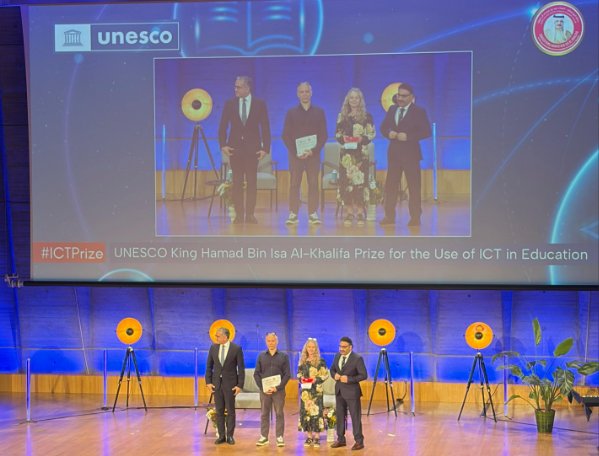
Generation AI is one of two recipients of the 2026 UNESCO King Hamad Bin Isa Al-Khalifa Prize for the Use of Information and Communication Technologies (ICTs) in Education. The other laureate is the Redação Paraná programme from the State of Paraná, Brazil.
The recipients were selected from more than one hundred nominations submitted by UNESCO Member States and partner organisations. The prize was presented on 9 September at UNESCO headquarters in Paris as part of the Digital Learning Week event, held this year under the theme Education in the age of AI: Facts | Frictions | Frontiers.
UNESCO's international expert jury drew particular attention to the strength of the evidence behind Generation AI. The project develops open tools, learning materials and pedagogical models that help learners move beyond passive use of AI to investigate, evaluate, build and reshape AI systems themselves.
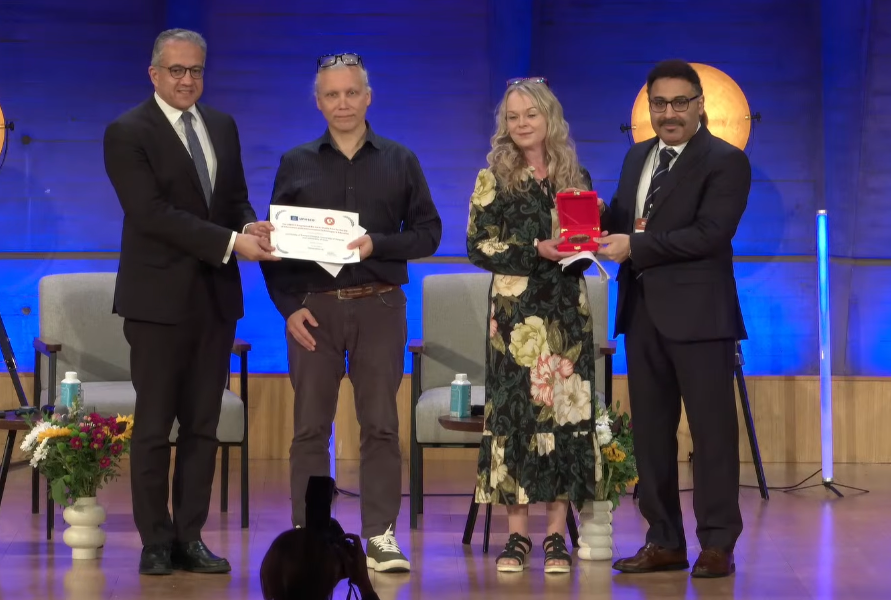
In introducing the laureates, UNESCO highlighted the project's international reach and evidence base:
"Generation AI gives learners free open source tools to build, question and redesign AI systems, moving them beyond passive AI use. Its resources have been accessed over 200,000 times across more than 50 countries, demonstrating the scalability of the initiative beyond the Finnish borders. What particularly impressed the jury was the strength of the evidence behind Generation AI, with numerous peer-reviewed studies demonstrating sustained and rigorous scientific research into critical thinking and creativity with AI, and also providing an important exemplar of evidence-led approaches to utilizing AI in education."
AI literacy is for everyone
The prize was received by the leader of Generation AI, Professor Matti Tedre, and University Researcher Henriikka Vartiainen from the University of Eastern Finland.
In his acceptance speech, Tedre highlighted the impact of AI on everyday life, decision-making, communication and how knowledge is created. AI is used much more widely than the most visible generative AI applications suggest, yet most people still know very little about how these systems actually work.
"If AI is changing how we live, how we decide, and what we know, then shouldn't everyone understand how it works, where it's used, and all that?" Tedre asked in his speech.
According to Tedre, the societal impact of AI is too significant for its direction to be shaped by only a few. Meaningful participation, however, requires that people have the knowledge and capacity to understand AI systems and their effects.
The speech gave particular thanks to the teachers, children and the project's research team who have contributed to the long-term co-development of the tools and materials.
Beyond using AI – assessing and shaping it
In her remarks, Henriikka Vartiainen described the pedagogical foundations of Generation AI. Its starting points are equity, social justice and children's right to learn AI literacies.
"It is not just about how AI systems are used, but also about how they are critically assessed, shaped and made," Vartiainen said.
Generation AI's pedagogical models and educational technologies have been developed through interdisciplinary research together with hundreds of teachers, pre-service teachers and children. According to Vartiainen, policy decisions concerning education should be based on research rather than opinion.
The project's aim is not only to help people adapt to technological change. Its purpose is to strengthen transformative data agency: people's capacity to examine AI scientifically, critically and ethically, to question existing practices and to imagine and build alternatives.
"Education shouldn't be about adapting to technological change, but cultivate transformative data agency," Vartiainen emphasised.
Research-based tools in more than 50 countries
Generation AI is a multidisciplinary research programme developed by the University of Eastern Finland, the University of Helsinki and the University of Oulu together with other partners. It produces research-based pedagogical models, learning materials and open tools for exploring how AI works and how it affects society.
According to UNESCO, the project's materials and tools have been accessed more than 200,000 times in over 50 countries. Around 1,500 students and teachers have taken part in the project's workshops and school-based interventions.
Generation AI's tools allow learners to build classifiers based on machine learning, examine social media profiling and recommendation algorithms, investigate biases in AI systems and train their own small language model. The tools are designed to open up the workings of AI in practice without requiring prior programming skills.
Watch the award ceremony and speeches
The presentation of the Generation AI prize and the speeches by Professor Matti Tedre and University Researcher Henriikka Vartiainen can be viewed in the UNESCO Digital Learning Week recording. The video starts at the point of the prize presentation.
The texts below are transcripts of Matti Tedre's and Henriikka Vartiainen's speeches at the ceremony. They have been lightly edited for readability without changing their content.
Read Matti Tedre's acceptance speech
Good afternoon, Excellencies, Director-General, experts and so many friends in research that we have here.
Thank you for the opportunity to share our vision for AI literacy here on the stage. It's really humbling to be here. We never thought it would happen.
There are so many to thank, but we really, really want to thank the teachers, the children and our research team that has worked with us for so many years in developing our resources and tools.
So for those who don't yet know what Generation AI is about, let me quickly give an overview of it.
Starting from yesterday, where the ministerial meeting began by saying AI is too consequential to be shaped by a few, then came a crucial point: this must be backed with capacity. And this is what our project is about – giving people the capacity to do that.
When we started our work roughly ten years ago, we started because we already saw a fundamental shift underway. A shift in how we work, a shift in how we communicate our ideas, a shift in how we connect to other people.
We saw a shift in how we buy, how we play, how we spend, how we date, how we commute – everything, really. Yet we don't even know where AI is used in our lives, here and there. Little sprinkles of this and that AI here and there – yet most of us have very little idea even about that, and about how all of this works, the mechanisms of it all.
And the shift goes even deeper still, and this is super important. We saw a coming shift in how science is done, in how knowledge is created.
Because science is no longer what it used to be. The tools have changed, the mechanisms have changed, the methods have changed, and the questions we ask in the sciences have changed. And none of those questions are about ChatGPT. They are about a whole range of different kinds of AI doing this and that differently in the sciences.
And in Generation AI, we focus on these different kinds of AI in our world.
So our question became really simple: if AI is changing how we live, how we decide, and what we know, then shouldn't everyone understand how it works, where it's used, and all that?
So let me step aside and let my colleague Henriikka talk about our pedagogy in the project.
Read Henriikka Vartiainen's acceptance speech
Thank you.
First, we have to start from the values that we share. Our work is grounded on educational values like equity, social justice and children's rights to learn AI literacies.
This includes the understanding of the key concepts and mechanisms behind AI systems. Not just how to use them, but how to critically assess them, shape them and also make them.
Secondly, policy decisions shouldn't be based on opinions. We say they should be backed with research – a lot of research.
Our work builds on interdisciplinary research and cross-boundary co-design. Over the years, we have been working very closely with hundreds of teachers, pre-service teachers and children to develop research-based pedagogical models and educational technologies for transformative AI education.
And thirdly, education shouldn't be about adapting to technological change, but cultivating transformative data agency.
It's about developing scientific, critical and ethical understanding so that people can analyse and question existing practices, imagine alternatives and take informed action towards more just and sustainable AI futures.
Read Matti Tedre's closing remarks
Everything we do in the project is open and free. The research reports, the classroom material and the technology – all the AI education tools that our team develops are open source, available on GitHub. You can take them, you can make them better, you can put your own logo on them. We are just happy if they get used.
Yesterday we heard that AI is too important to be shaped by a few. And we believe the same is true of AI literacy too.
AI literacy is way too important to be defined by whoever sells their technology best. It has to be built on research, on facts. It has to be supported by good policy, led by confident teachers, and shaped with children, with families, with communities – not just shaped for them.
Because AI literacy is not about teaching everybody to become an AI expert. It's about making sure everybody has the capacity to have a say about AI. And if AI is going to shape all our futures, then all of us must have the power to also shape AI.
And this is our project. Come see us on the last day, in the last session, where we show how kids can create their own AI tools. Thank you.
About the prize
The UNESCO King Hamad Bin Isa Al-Khalifa Prize for the Use of Information and Communication Technologies in Education has been awarded annually since 2005 and is supported by the Kingdom of Bahrain. Each year it highlights projects and approaches that use digital technology responsibly to enhance teaching and learning.
The 2026 edition focused on uses of AI that support learners' critical thinking, creativity and imagination.